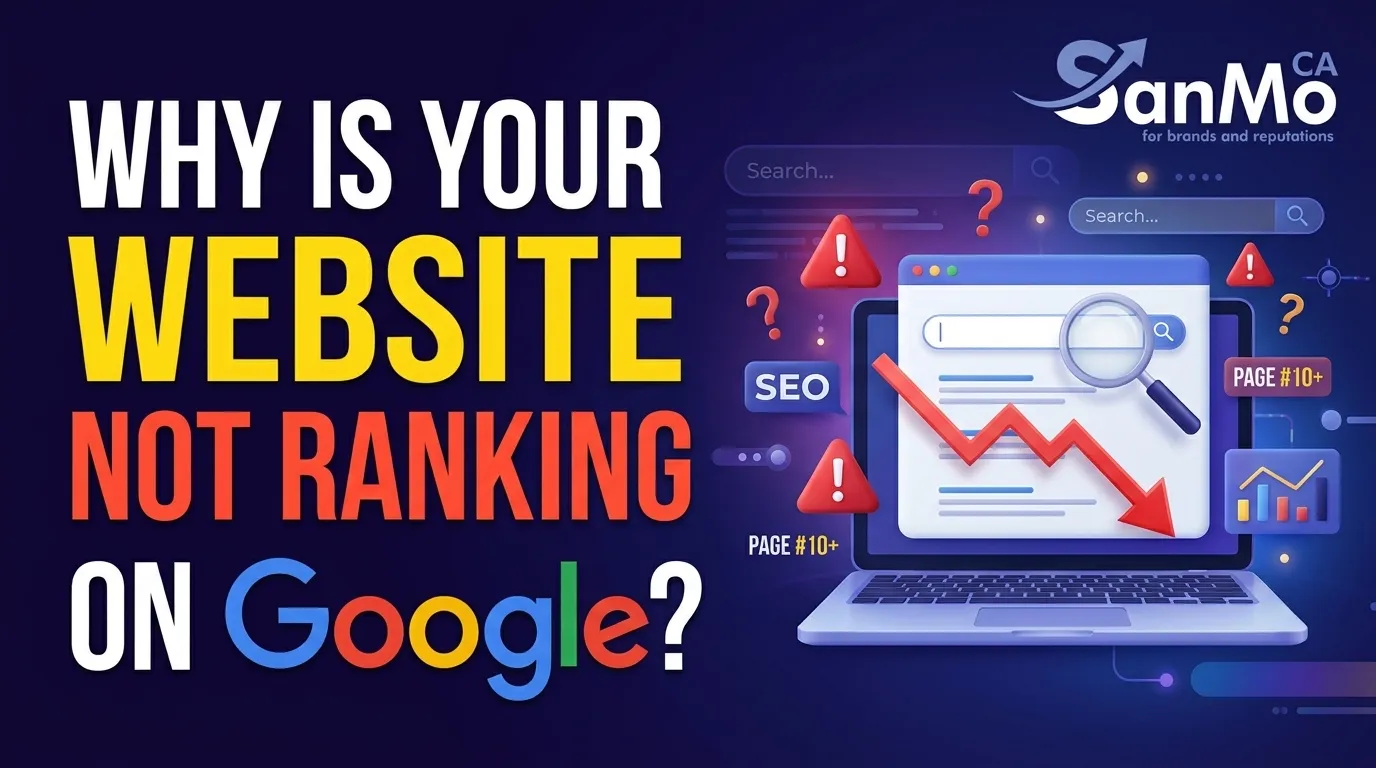
Having a website does not automatically guarantee visibility on Google. If your website is not ranking on Google, several factors could be responsible, including poor keyword targeting, weak content quality, technical SEO errors, slow loading speed, poor mobile performance, a lack of quality backlinks, and indexing problems. Google evaluates websites based on relevance, usefulness, user experience, and overall quality before deciding which pages deserve higher positions in search results. In this guide, we will explore the most common website ranking problems, explain why your website may not be appearing in Google search results, and discuss practical SEO strategies to improve visibility, attract organic traffic, and achieve long-term ranking growth.
Why Website Is Not Ranking on Google
One of the most frustrating situations for website owners is publishing high-quality content but receiving little or no organic traffic. You may have invested time and money in website design, content creation, and digital marketing, yet your pages still do not appear on the first few pages of Google. Understanding why your website is not ranking on Google is the first step toward finding the right solution. Google uses complex algorithms to evaluate billions of web pages and determine which results are most relevant to a user’s search query. Your website must demonstrate relevance, authority, content quality, and a positive user experience to compete effectively in search results.
Sometimes, the problem is related to keyword targeting. Your content might focus on keywords that are too competitive, have little search demand, or do not match what your target audience is actually searching for. In other cases, your website may have technical problems that prevent Google from discovering or understanding your pages. Another important factor is competition. Even if your website follows basic SEO practices, competitors may have more comprehensive content, stronger backlinks, better website structures, and greater authority in your industry. Instead of making random SEO changes, identify the actual problems affecting your website. A detailed SEO audit can help you understand whether your challenges are related to content, technical performance, keyword selection, or website authority.
Website Ranking Problems
Website ranking problems can develop gradually or appear suddenly. A website that previously received consistent organic traffic may experience declining visibility because of algorithm changes, technical errors, increased competition, or changes in search demand. One common problem is publishing content without a clear SEO strategy. Many businesses create blog posts around general topics without researching whether people are searching for those subjects. As a result, their content may receive very few impressions because it does not target relevant search queries.
Content duplication is another issue that can affect website performance. When several pages contain nearly identical information, search engines may struggle to determine which page should appear in search results. This can create keyword cannibalization, where multiple pages compete for the same search terms instead of strengthening one authoritative page. Poor internal linking can also create difficulties. Internal links help Google discover related pages and understand the relationship between different topics on your website. If important pages receive no internal links, search engines and visitors may have difficulty finding them.
Additionally, outdated information, thin content, broken links, and poor navigation can reduce the overall quality of your website. To solve website ranking problems, review your existing content, examine Google Search Console data, check your internal linking structure, and identify pages that need updating or improvement. A consistent SEO strategy is more effective than repeatedly publishing content without measuring its performance.
Reasons for Low Google Rankings
 There are several reasons why a website may struggle to achieve higher positions in Google search results. Understanding these reasons helps website owners make informed decisions instead of wasting resources on SEO activities that do not address the real problems. One major reason is insufficient content quality. Google aims to provide users with helpful, relevant, and trustworthy information. If your articles provide only basic explanations without answering the searcher’s actual questions, competing websites with more useful information may perform better.
Another reason is weak keyword research. Targeting highly competitive keywords without considering your website’s current authority can make ranking extremely difficult. For example, a newly launched website may struggle to compete for broad industry keywords against established websites. Choosing more specific, relevant search terms can create better opportunities. Backlink quality also plays an important role in building website authority. When relevant and trustworthy websites link to your content, these links can help search engines understand that your website offers valuable information. However, buying artificial backlinks or participating in manipulative link schemes can create serious SEO risks.
User experience is another consideration. Visitors expect websites to load quickly, display correctly on mobile devices, and provide easy navigation. If your website creates unnecessary difficulties, users may leave without engaging with your content. If your website is not ranking on Google, examine these areas together rather than assuming that one SEO factor is responsible for every ranking problem.
How to Improve Website Ranking on Google
Improving your website’s Google rankings requires a combination of technical optimization, high-quality content, keyword research, internal linking, and authority building. There is no guaranteed shortcut to the first page, but following a consistent SEO strategy can improve your chances of achieving sustainable results. Start by understanding your target audience and identifying the search terms they use when looking for your products, services, or information. Your keywords should match the purpose of each page and reflect what potential customers actually want to find.
For a deeper understanding of keyword selection, read our guide on how to find the best keywords for your website. Proper keyword research helps you identify relevant search opportunities, understand search intent, and create content that addresses your audience’s needs. Once you identify suitable keywords, optimize your website pages naturally. Include your primary keyword in the page title, main heading, introduction, relevant subheadings, URL, and meta description where appropriate. Avoid keyword stuffing because excessive repetition can make content difficult to read and may violate Google’s spam policies.
Content optimization is equally important. Create detailed articles that answer user questions, explain topics clearly, and provide useful information that readers cannot easily find elsewhere. Update outdated pages, improve weak sections, and add relevant internal links to related content. You should also improve website speed, mobile usability, navigation, and security. A well-structured website makes it easier for visitors to explore your content and for search engines to understand your pages. Finally, monitor your performance through Google Search Console and Google Analytics. Review impressions, clicks, average positions, and organic traffic to understand which improvements are producing positive results.
Common SEO Mistakes
Many businesses struggle with organic search visibility because they repeatedly make SEO mistakes without realizing their long-term impact. Even a visually attractive website can perform poorly if its underlying SEO strategy is weak. One common mistake is keyword stuffing. Some website owners believe that repeating their target keyword dozens of times will automatically improve rankings. However, unnatural keyword repetition reduces readability and can make content appear manipulative. Keywords should fit naturally into meaningful sentences.
Another mistake is publishing low-quality or AI-generated content without proper editing, research, or fact-checking. AI tools can help with content creation, but simply producing large quantities of generic articles does not guarantee better rankings. Content should demonstrate real value, relevant expertise, and a clear understanding of the reader’s needs. Ignoring search intent is also a major problem. Someone searching for information about SEO may want a detailed educational guide, while someone searching for an SEO agency may be looking for professional services. Creating the wrong type of page for a keyword can limit its ranking potential.
Other mistakes include neglecting mobile optimization, ignoring broken links, using duplicate title tags, forgetting image alt text, and building irrelevant backlinks. Businesses should also avoid constantly changing URLs without implementing proper redirects. Unnecessary URL changes can create broken pages and disrupt existing search visibility. Avoiding these common mistakes and maintaining a consistent SEO process can help improve website performance over time.
Google Search Ranking Factors
 Google considers many signals when determining which pages should appear in search results. Although its ranking systems are complex and constantly evolving, several important areas deserve attention when developing an SEO strategy. Content relevance is one of the most important considerations. Your page should directly address the topic and match the intent behind the search query. Content that clearly answers a user’s question has a better opportunity to compete than pages that provide unrelated or incomplete information.
Content quality and originality also matter. Google aims to reward helpful, reliable, people-first content. Articles should provide accurate information, explain subjects thoroughly, and offer genuine value rather than simply repeating information available on other websites. Website usability is another important area. Google’s Core Web Vitals measure aspects of loading performance, interactivity, and visual stability. These metrics help website owners understand how visitors experience their pages, although they should be considered alongside other ranking factors.
Mobile-friendliness, secure browsing through HTTPS, logical website architecture, and accessible navigation also contribute to a strong website experience. Backlinks can help establish authority and credibility when they come from relevant, trustworthy sources. However, the quality and relevance of links are more important than simply collecting a large number of them. Businesses targeting specific locations should also focus on local SEO, accurate business information, and relevant local content. Understanding these factors makes it easier to build a balanced strategy instead of focusing exclusively on one ranking signal.
Website Not Appearing in Google Search Results
Sometimes, the problem is more serious than low rankings. Your website may not appear in Google search results at all, even when you search for its exact name or a specific page title. One possible explanation is that Google has not indexed your website yet. New websites and recently published pages may take time to be discovered, crawled, and indexed. Indexing is not guaranteed, and submitting a page does not mean Google will automatically include it in search results. Another possibility is that your website contains a noindex directive. This instruction tells search engines not to include a particular page in their search index. If it is accidentally added to important pages, those pages may disappear from search results.
A robots.txt file can also restrict search engine crawlers from accessing certain sections of your website. Although robots.txt is useful for managing crawling, incorrectly configured rules can prevent Google from discovering important content. You should also check whether your website has manual actions or security issues through Google Search Console. These reports can help identify problems that may affect search visibility. To investigate the issue, enter your website’s URL into Google’s URL Inspection tool. Check the indexing status, crawling information, canonical URL, and any reported errors. If your website is not ranking on Google because important pages are missing from its index, resolving indexing and accessibility problems should be your priority before focusing on additional content or link-building campaigns.
Technical SEO Issues Affecting Rankings
Technical SEO ensures that search engines can discover, crawl, understand, and index your website efficiently. Even excellent content may struggle to perform if technical problems prevent Google from accessing important pages. Website speed is one area worth investigating. Large images, unnecessary scripts, poor hosting performance, and excessive plugins can increase loading times. Compressing images, using efficient caching, optimizing code, and choosing reliable hosting can help improve performance.
Mobile responsiveness is equally important. Your website should display properly across smartphones, tablets, and desktop computers. Text should be readable, navigation should be accessible, and visitors should not need to zoom or scroll horizontally to use your pages. Another important technical element is the XML sitemap. It provides search engines with information about the URLs you want them to discover. Submitting an accurate sitemap through Google Search Console can support the discovery of important pages.
Canonical tags help identify the preferred version of similar or duplicate URLs. Incorrect canonical settings can cause Google to select an unintended page for indexing. Broken links, redirect chains, server errors, incorrect structured data, and HTTPS configuration problems should also be checked regularly. A technical SEO audit helps uncover these issues and provides a clear direction for fixing them. If your website is not ranking on Google despite having relevant content, technical SEO should be one of the first areas you investigate.
How to Increase Organic Website Traffic
 Increasing organic website traffic requires more than publishing blog posts and waiting for visitors to arrive. You need a content strategy that targets relevant keywords, satisfies search intent, and consistently provides useful information. Start by creating content around topics that are important to your audience. Instead of writing unrelated articles, organize your content into topic clusters. A main guide can cover a broad subject, while supporting articles explore specific questions and related topics. Connect these pages through relevant internal links to create a logical content structure.
Content updates are another effective strategy. Review older articles to identify outdated information, missing sections, broken links, and opportunities to improve keyword targeting. Refreshing existing content can be valuable when the information needs improvement and the page already has search visibility. Building relevant backlinks can also support organic growth. Focus on creating useful resources, publishing original insights, contributing expert commentary, and developing relationships with relevant websites. For additional guidance, explore our article on ethical link-building techniques that deliver lasting results. Businesses can also expand their organic reach by optimizing service pages, creating location-specific content where appropriate, and answering common customer questions.
Track your results regularly. Google Search Console helps identify which queries generate impressions and clicks, while Google Analytics provides information about website traffic and visitor engagement. Remember that sustainable organic growth takes time. Consistent improvements in content quality, technical performance, and website authority can gradually strengthen your search visibility.
Google Indexing and Crawling Issues
Crawling and indexing are essential processes that allow Google to discover and display website pages in search results. Understanding the difference between these processes can help you diagnose why certain pages are not appearing on Google. Crawling happens when Google’s automated systems, known as Googlebot, visit website pages and follow links to discover content. Indexing occurs when Google processes information about a page and determines whether it should be included in its search index.
A crawling problem occurs when Google cannot properly access a page. This may happen because of server errors, blocked resources, incorrect robots.txt rules, or website accessibility issues. An indexing problem occurs when Google can access a page but decides not to include it in its search index. Reasons may include duplicate content, insufficient value, incorrect canonical tags, or a noindex instruction.
Google Search Console provides useful reports for understanding these problems. The Page Indexing report shows different indexing statuses and helps identify pages that are excluded from Google’s index. The URL Inspection tool allows you to investigate individual URLs, review their indexing status, and request indexing when appropriate. However, requesting indexing does not guarantee that Google will index the page or improve its ranking. You should also maintain a clean website structure, create useful internal links, keep your sitemap updated, and ensure that important pages are accessible to search engines. Resolving Google indexing and crawling issues creates a stronger foundation for your overall SEO strategy. Once search engines can access and understand your website properly, you can focus on improving content quality, relevance, and authority.
Conclusion
Getting your website to rank on Google requires patience, planning, and continuous improvement. Low rankings are not always caused by a single SEO mistake. In many cases, several issues involving content quality, keyword targeting, technical performance, website authority, and indexing work together to limit search visibility. The most effective approach is to identify your website’s weaknesses, prioritize the problems that have the greatest impact, and follow a consistent SEO strategy. Focus on creating helpful content, improving user experience, building relevant backlinks, and making your website accessible to search engines. With regular monitoring and the right optimization techniques, you can strengthen your website’s search presence, attract more qualified organic visitors, and build sustainable online growth.
FAQ
1. Why is my website not ranking on Google?
Your website may not rank because of poor keyword targeting, weak content quality, technical SEO errors, insufficient backlinks, indexing problems, or strong competition. Conducting a complete SEO audit can help identify the specific reasons behind your website’s poor performance.
2. How long does it take for a website to rank on Google?
There is no fixed timeline for Google rankings. New websites may take several months to establish organic visibility, while competitive keywords can require much longer. Results depend on competition, website authority, content quality, technical performance, and SEO consistency.
3. How can I check whether Google has indexed my website?
You can use Google Search Console’s URL Inspection tool to check whether individual pages are indexed. You can also search Google using the site: operator followed by your domain name to see pages that Google has indexed.
4. Can poor website speed affect Google rankings?
Yes. Website speed and user experience are important considerations in SEO. Core Web Vitals measure loading performance, interactivity, and visual stability. Improving these areas can provide a better experience for visitors and support your overall SEO efforts.
5. Why is my website losing Google rankings?
Ranking drops can happen because of algorithm updates, increased competition, outdated content, technical errors, lost backlinks, changes in search intent, or reduced content quality. Reviewing Google Search Console and comparing historical performance can help identify potential causes.
6. Are backlinks still important for Google rankings?
Yes. Relevant and trustworthy backlinks can help establish website authority and provide additional discovery paths. However, buying spammy links or participating in manipulative link schemes can create risks. Focus on earning natural, relevant backlinks through valuable content and genuine relationships.
7. Does publishing more blog posts improve Google rankings?
Publishing more articles does not automatically improve rankings. Content should be useful, original, relevant, and aligned with search intent. A smaller collection of high-quality articles can perform better than hundreds of thin or repetitive pages.
8. What is the best way to improve website ranking on Google?
The best approach is to combine proper keyword research, high-quality content, technical SEO, mobile optimization, relevant internal links, and ethical link building. Regularly monitoring performance through Google Search Console also helps you make informed improvements.
9. Can AI-generated content rank on Google?
Yes. AI-assisted content can appear in Google search results when it provides original value, accuracy, relevance, and a positive user experience. However, publishing large amounts of unhelpful or automatically generated content without meaningful quality control can violate Google’s spam policies.
10. What should I do if my website is not appearing in Google search results?
First, check whether your website and important pages are indexed using Google Search Console. Then investigate robots.txt restrictions, noindex tags, server errors, canonical settings, and manual actions. Fix any identified issues and request indexing for eligible pages.